

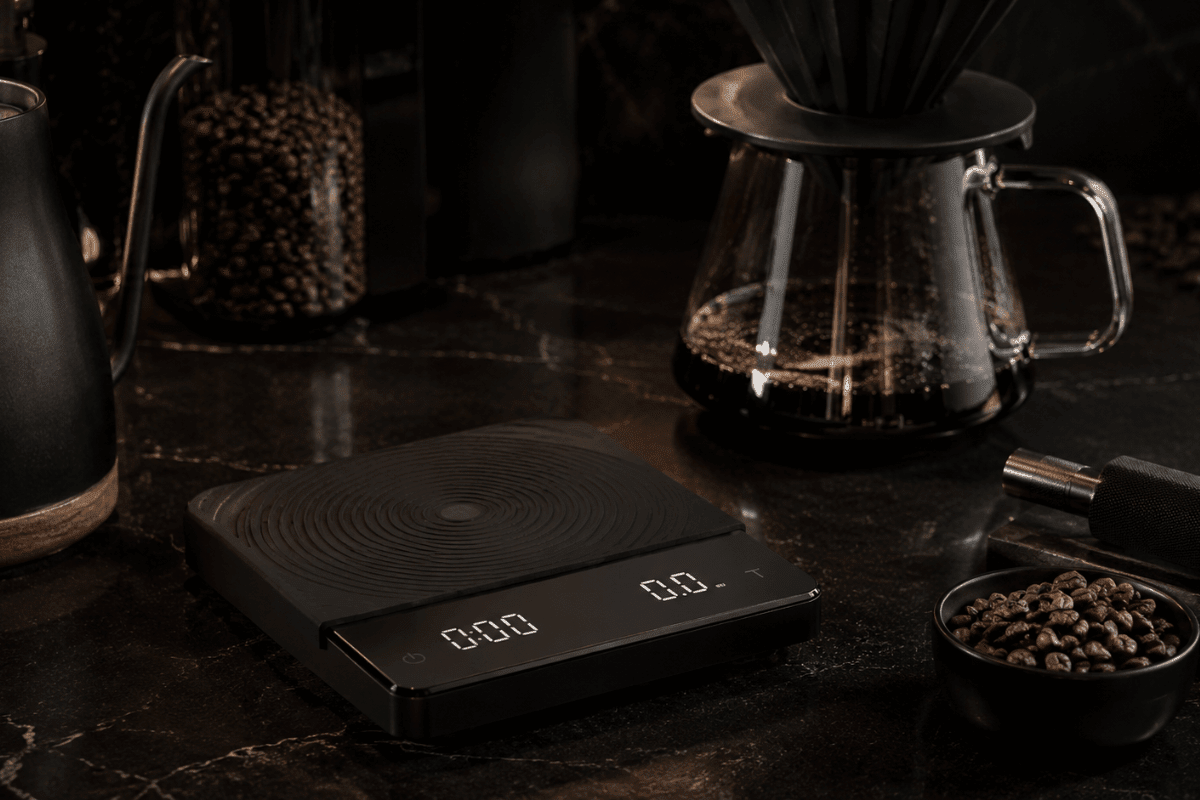
A coffee scale is the most underrated piece of gear in any home setup. It costs less than a bag of specialty beans, takes up almost no space, and immediately closes the gap between inconsistent results and a great cup every single morning. Most people skip it — and their coffee suffers for it every day.
Here's why that one small change makes such a significant difference, and what to look for when you're ready to add one to your setup.
The Problem With Scoops and Tablespoons
Every brew guide you've ever read probably gave you a measurement in tablespoons or scoops. The problem is that volume measurements are deeply inconsistent with coffee.
A tablespoon of finely ground espresso weighs significantly more than a tablespoon of coarsely ground pour-over. The same scoop can vary by 20–30% depending on how the coffee was ground, how settled it is, and how you filled it. That variance directly affects extraction — and extraction is everything when it comes to taste.
Without a scale
Different results every morning. Too strong some days, too weak others. No way to replicate a cup you loved or fix one that missed.
With a scale
Identical results every time. When you find the ratio that tastes perfect, you can repeat it exactly — indefinitely.
What a Scale Actually Measures
For pour-over and filter coffee, a scale measures two things: the weight of your dry coffee grounds going in, and the weight of water you pour over them. This gives you a precise brew ratio — typically expressed as 1:15 or 1:16 (one gram of coffee per 15 or 16 grams of water).
For espresso, a scale measures your dose in and your yield out — the weight of the shot that lands in the cup. Espresso recipes are typically written as ratios like 18g in, 36g out. Without a scale, you're guessing both numbers.
The Timer Is Just as Important as the Weight
A coffee scale with a built-in timer — like the TIMEMORE Black Mirror — is specifically designed for brewing. You start the timer the moment water touches coffee, and you track both the weight of water added and the total brew time simultaneously.
This matters because extraction is a function of both dose and time. You can have perfect ratios and still produce a bad cup if your brew time is off. The timer closes that final loop.
Response time matters more than most specs. A scale that updates slowly makes pour-over brewing frustrating — you'll always be overshooting your target weight. Look for a scale with 0.1g precision and a response time under 0.5 seconds. The TIMEMORE Black Mirror was designed specifically for this use case.
The Repeatability Factor
Here's the real reason serious home baristas use a scale: repeatability. The goal isn't just to make one great cup — it's to make the same great cup every morning without having to think about it.
When you find a ratio that works — say, 17g of your favorite Ethiopian beans to 255g of water at 200°F, brewed in 3:15 — you can write it down and repeat it exactly tomorrow. And the day after. Without a scale, that cup exists once and then disappears into guesswork.
Who Needs a Coffee Scale
If you brew pour-over, a coffee scale is essentially non-negotiable. The entire method is built around controlled ratios and timing — trying to do it without measuring is like baking without measuring cups.
If you pull espresso, a scale dramatically speeds up the process of dialing in. Instead of tasting shot after shot trying to find the sweet spot, you measure your way to it systematically.
Even if you use a standard drip machine, a scale ensures you're dosing correctly every time — which is the single most common reason home drip coffee tastes flat or weak.
A Small Tool With an Outsized Impact
In a hobby full of expensive gear and marginal improvements, the coffee scale is one of the rare purchases that punches well above its price. It won't make your beans taste better. It won't fix a bad grinder. But it will make everything else you already own perform at its best — consistently, predictably, every morning.
That's worth a lot more than most people realize until they try it.
Shop Coffee Scales
Share:
How to Build Your Home Coffee Station
How to Choose Your First Home Espresso Machine (2026 Guide)